MAFWA News and Updates
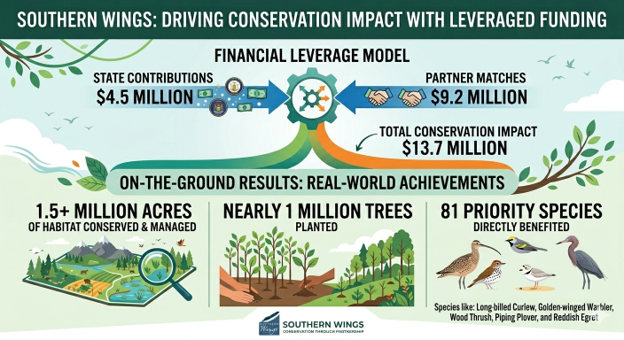
When state fish and wildlife agencies invest millions of dollars into breeding habitat restoration, nest monitoring, and local land conservation, they are doing vital stewardship work. But for Neotropical migratory species—like the Wood Thrush, Cerulean Warbler, and Bobolink—in-state conservation is only half the story. If these birds face habitat loss and fragmentation on their wintering grounds in Latin America and the Caribbean, local conservation investments risk falling short. Enter Southern Wings, a science-driven, state-led initiative that enables agencies to conserve their migratory species across their full annual cycle—much like states have successfully done for waterfowl in Canada for decades. The 25% Challenge: Securing the Full Annual Cycle To maintain momentum and scale hemispheric conservation, Southern Wings has issued the 25% Challenge: The Goal: Reach at least 25% of your state’s annual Southern Wings investment goal, or increase your agency's contribution by 25% this year. Collective Target: Reaching a collective $2M annual investment. States who step up to meet or exceed the challenge will be formally recognized during the Southern Wings Achievement Awards Luncheon at the upcoming AFWA Annual Meeting. The Economic Return on Investment (ROI) Beyond biological stewardship, conserving migratory birds directly safeguards state outdoor economies. Birds are massive economic drivers: Ohio: Home to 3.5 million birdwatchers (ranking #7 nationally). With 91% of the state’s 4.1 million wildlife viewers seeking birds, birding generates $1.6 billion annually in local economic impact. Minnesota: Home to nearly 1.8 million birdwatchers. Overall, wildlife watchers generated $5.0 billion in spending in 2022. This economic activity relies heavily on birds returning to our backyards and natural areas each spring. Join the Challenge Whether your agency is looking to join Southern Wings for the first time or expand its current participation, your contribution directly protects your state’s biological heritage and economic investments. To learn more about your state's specific investment goal or to discuss partnership opportunities, reach out to Deb Hahn or Bradley Wilkinson .

Ohio Division of Wildlife shares 2025 review and what's to come in 2026 (PDF)
Mystery solved: Elusive cougar cubs documented again in Michigan Posted on December 18, 2025 , by admin Nine months after two cougar kittens were documented in the Upper Peninsula, a new trail camera photo indicates the elusive animals are still alive and living with their mother. Michigan DNR News Dec. 18, 2025 Contact: Brian Roell , DNR biologist The Michigan Department of Natural Resources verified the Dec. 6 photo of an adult cougar being followed by two kittens down a snowy trail in central Ontonagon County. The last time the kittens were documented – in early March – they were only about two months old and their mother was nowhere in sight, raising concerns about the kittens’ survival. But the newly verified photo shows an adult cougar with two juvenile cougars that appear to be about a year old, according to Brian Roell, the DNR’s large carnivore specialist. Michigan is home to very few cougars and genetic testing has confirmed the existence of only adult males. The new photo suggests one of the first instances of cougar reproduction to take place outside the cougars’ core area in the Western states. “This is a historic confirmation for Michigan since it is the first time in over 100 years that verified cougar reproduction has occurred east of the Mississippi River and possible even east of the Missouri River,” Roell said. A private landowner sent the trail camera photo of the cougars to the DNR on Sunday, Dec. 14. Roell verified the site of the photo Monday and the DNR’s cougar team confirmed the photo Tuesday by enhancing the nighttime image to verify the existence of the three cougars. The sex of the kittens is unknown. Cougar kittens, or cubs, generally stay with their mother for about two years before venturing out on their own. “The kittens’ chances of survival are actually pretty high because just like bears, cougars invest a lot of their energy into their young,” Roell said. “So these kittens will stay with their mom through this winter and possibly even into next winter. They already have a leg up, seeing as how they’ve been with her for a year now.” Roell is surprised the cougar kittens weren’t documented from any public or private trail cameras since March. The DNR operates more than 1,300 trail cameras in the U.P. to survey wildlife abundance. “The interesting thing is, where were they for nine months?” Roell says. “That’s a mystery.” Native to Michigan, cougars were essentially hunted out of the state by the early 1900s. Since 2008, the DNR has confirmed about 168 cougar sightings, all in the U.P., although most of those sightings are of the same animal being reported by multiple sources, Roell said. Cougar sightings have increased each year since 2019, Roell added, but the number of trail cameras has also increased. Cougar sightings on DNR-operated cameras accounted for more than 25% of the verified cougar sightings in 2024. Visit the DNR’s cougar dashboard and cougar photo page for more information. In addition to the cougar kittens in Michigan, there have been more cougars reported in other areas, including Nebraska. However, cougars need vast territories because they are solitary ambush predators that rely on deer and other large prey, which leads to low population densities. Even states with the largest cougar populations generally have just a few thousand of the animals. “This isn’t an animal that is ever going to become very numerous,” Roell said. “They’re going to remain rare on the landscape regardless of whatever happens with them here in Michigan.” Cougars are on the list of endangered mammals in Michigan, meaning it’s illegal to hunt or harass them, which includes trying to locate their den on public or private property. “Too much human pressure can also trigger the female cougar to abandon her cubs,” Roell said. “As with all wild animals, we’re asking the public to respect their habitat and allow them to live naturally in their home.”
Posted on December 17, 2025 by admin WMI Outdoor News Bulletin December 2025 Edition – Volume 79, Issue 12 As NFWF launches its first NextGen Business Plan, states have a timely chance to align their wildlife action plans with long-term, large-scale investment and influence conservation for decades to come. At a time when conservation challenges are expanding faster than the capacity to meet them, a unique opportunity has emerged, one that connects the next generation of State Wildlife Action Plans (SWAPs) with the National Fish and Wildlife Foundation’s (NFWF) new 30-year NextGen Business Plans. This alignment offers an opportunity to link state-led conservation priorities with large-scale investment strategies that can shape the course of wildlife conservation for decades ahead. The collaboration grew out of discussions among members of the AFWA–U.S. Fish and Wildlife Service Joint Task Force on Landscape Conservation and NFWF about 18 months ago, exploring how the three partners (states, the Service, and NFWF) could work in a more strategically aligned and mutually reinforcing way. Those early conversations identified a shared opportunity to test how NFWF’s long-term investment framework could intentionally connect to the priorities and science that underpin State Wildlife Action Plans. From Parallel Paths to Converging Frameworks For two decades, SWAPs and NFWF’s business plans have advanced on parallel tracks. SWAPs, first completed in 2005 and revised in 2015, form the backbone of state-led, science-based conservation, built around eight core elements that identify species and habitats of greatest conservation need and guide monitoring, coordination, and public engagement. During that same period, NFWF’s plans evolved from Keystone Initiatives focused on individual species to Landscape Business Plans addressing ecosystems, watersheds, and partnerships. Now, as states finalize their third-generation SWAPs and NFWF launches its NextGen Business Plans, the timing is serendipitous. Both frameworks are being renewed in 2025, opening a shared window to align planning and investment for the next 30 years. The Southeast Pilot: A Model in the Making NFWF That alignment is being explored through the Southeast Forests and Rivers Pilot, the first of sixteen NextGen plans that will ultimately span the nation. The pilot builds on the longleaf-pine ecosystem, the same focus that anchored NFWF’s earlier Longleaf Forests and Rivers plan, while expanding to encompass a broader range of forest, grassland, and aquatic systems. In this way, the longleaf ecosystem remains core to a more inclusive regional framework that reflects both ecological and community interconnections. The NextGen model marks a significant evolution in approach. It extends the planning horizon from 10 years to 30 years, creating space for more durable partnerships, adaptive learning, and long-term outcomes. It also moves from focusing on what is probable under foreseeable funding to what is needed to achieve lasting conservation results, a bold reframing that better matches investment strategies to the scale and urgency of the challenge. Together, these shifts illustrate how NFWF is building a more forward-looking approach to conservation design and implementation. NFWF is also broadening its focus from targeted species conservation investments to whole-system outcomes, combining habitat-suitability modeling, ecosystem services, and community resilience. This marks a shift from transactional coordination toward a more relational, co-developed partnership that emphasizes shared learning and trust. Because both SWAPs and NextGen plans operate on ten-year cycles, they will intersect twice more over the next three decades. This adaptive feedback loop means each new SWAP can inform NFWF’s next round of investment, while NFWF’s measurable outcomes can help guide future SWAP revisions. Beyond a One-Off: Building a Pathway for Broader Alignment While the Southeast pilot is the starting point, it is not yet a finished model. It is a learning process designed to test how state-led priorities can best inform NFWF’s long-term investment strategies. Each of the fifteen NextGen plans that follow will focus on different landscapes, but the pathway being developed now in the Southeast can help shape how those future alignments take form. The longleaf ecosystem and its partnerships provide the first proving ground, but the real value lies in establishing an approach that can evolve and transfer across regions over time. Transitioning to full SWAP integration will not happen all at once. It will depend on the bridges and connective tissue that already link state and national efforts, such as the Southeast Conservation Adaptation Strategy (SECAS), the Midwest Landscape Initiative (MLI), the Northeast Landscape Committee, and western landscape initiatives, to connect planning with investment. Regionally Shared Species of Greatest Conservation Need (RSGCN) can also serve as integrators, linking biological priorities across state lines and aligning conservation design with NFWF’s outcome-based framework. Likewise, Conservation Opportunity Areas (COAs) identified through SWAPs and regional designs can spatially connect those priorities to on-the-ground implementation, providing another bridge between planning and investment. The goal is clear: to make state-led priorities foundational within NFWF’s business plans. Exactly how that happens will depend on working together through iterative learning, shared capacity, and continued collaboration among states, NFWF, and their regional partners. The opportunity to define that pathway exists now, while both planning cycles are open and the potential for alignment is at its strongest. The key is flexibility: unified but not uniform. State biological priorities and regional coordination capacity can guide where and how large-scale investments are made. NFWF If successful, this approach will demonstrate how SWAPs can serve as a national biodiversity framework, connecting local action to continental-scale investment through shared science and sustained collaboration. Anchored in AFWA’s Vision and the Relevancy Roadmap This emerging alignment reinforces the goals of AFWA’s newly adopted Resolution 2025-04-05, A Vision for Fish and Wildlife Conservation in the Future. That resolution calls for raising awareness of and securing funding for third-generation SWAPs, recognizing them as the unifying blueprint for proactive, collaborative conservation across jurisdictions. It also dovetails with AFWA’s Relevancy Roadmap, which emphasizes connecting conservation to community values: well-being, resilience, and economic vitality. NFWF’s NextGen framework echoes those same principles, linking ecological outcomes with social and economic benefits. By aligning with SWAPs, the NFWF business plans gain additional precision, credibility, and accountability, grounding large-scale investment strategies in the state-led science and priorities that Congress envisioned when it created the State Wildlife Grants Program. Together, these frameworks position SWAPs as more than technical plans and NFWF’s business plans as more than funding strategies, they become mutually reinforcing instruments for unifying investment, policy, and public engagement. Momentum Across Regions NFWF The convergence of planning and investment is also unfolding beyond the Southeast. In the Appalachian region, initiatives such as the Appalachian People and Places Collaborative and the Campaign for Appalachia are weaving biodiversity, cultural identity, and local economies into shared conservation goals. This work increasingly reflects a One Health approach; recognizing that ecological integrity, community well-being, and economic vitality are deeply interdependent and must advance together. Partners across these efforts have expressed strong interest in using SWAPs as a common biodiversity foundation that connects initiatives from Alabama to Canada, a vision consistent with the NFWF model now underway. Why Acting Now Matters NFWF expects to finalize the Southeast Forests and Rivers NextGen Business Plan by spring 2026, followed by fifteen additional plans. That means the blueprint for how SWAPs inform these plans and how regional partnerships are resourced to support them is being written now. At the same time, vulnerabilities in sustaining regional coordination capacity through partnerships such as SECAS, MLI and other landscape-level collaborations are creating challenges for maintaining continuity and shared learning at scale. NFWF Acting within this window underscores the essential role of regional coordination systems as the connective tissue linking state-led priorities in SWAPs to long-term, large-scale investment, and why sustaining that shared capacity will remain critical beyond this first phase of alignment. Looking Ahead This pilot offers an opportunity to build a practical and adaptable approach for linking state-driven science with broader-scale conservation investment, advancing AFWA’s vision and keeping SWAPs relevant and actionable for the long term. It also creates an opportunity for NFWF and other partners to align their investments more closely with the priorities, data, and relationships that states and regions have cultivated over two decades of shared planning, making those investments more relevant, coordinated, and enduring. By turning alignment into action, this collaboration can help ensure that large-scale conservation strategies stay connected to outcomes on the ground.