
MONARCH CONSERVATION
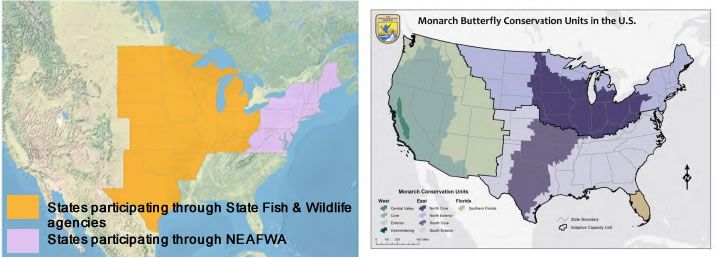
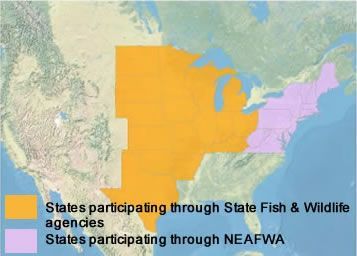
Monarch Conservation Geographic Priorities and Mid-American Monarch Conservation Strategy Geography.
Mid-America Monarch Conservation Strategy
Monarch Conservation Geographic Priorities and Mid-American Monarch Conservation Strategy Geography.
- 2023 Update To The Mid America Monarch Conservation Strategy (PDF)
- Summary Handout (PDF) (Content Unavailable)
- Q&A Messages for Mid-America Monarch Conservation Strategy (External Link)
- State Monarch Plans and Website Links (PDF) (Content Unavailable)
- Meeting Presentations (PDF) (Content Unavailable)
- Mid-America Monarch Conservation Strategy Members (Updated January 2019) (PDF) (Content Unavailable)
- Monarch Summit Guide(PDF)
Mid-America Monarch Conservation Strategy Overview
The 5-year update to the Mid-America Monarch Conservation Strategy is now available. This document includes updated monarch conservation science, a summary of progress towards habitat goals, information on the monarch butterfly species status assessment, and state-level summaries of monarch conservation activities. Please click here to download the PDF.
This Mid-America Monarch Conservation Strategy is built on state and partner planning efforts to identify conservation targets, programs, and coordinated strategies, providing a blueprint for successfully reversing monarch population decline through a landscape-scale, habitat-conservation approach. This Strategy is a living document and will be updated periodically as new information from states and partners becomes available, and as information from implementation and monitoring efforts, as well as new science, is evaluated within an adaptive management framework.
Please get in touch with Claire Beck, MAFWA Monarch Technical Coordinator, with any questions or comments about this Strategy at MidAmericaMonarch@gmail.com.
Description of Strategy
The core range of the eastern monarch butterfly extends beyond existing state and regional organizational structures, making coordinated conservation across state and regional lines challenging. The Midwest Association of Fish and Wildlife Agencies (MAFWA) has assumed a leadership role for monarch butterfly conservation in its mid-America range, which includes states in the Midwest and South-Central regions. MAFWA, in collaboration with the National Wildlife Federation, Pheasants Forever, the Association of Fish and Wildlife Agencies, and other partners, is developing a Mid-America Monarch Conservation Strategy to provide a framework for implementing, coordinating, and tracking monarch conservation efforts across at least 16 states.
The purpose of the Mid-America Monarch Conservation Strategy (Strategy) is to facilitate cohesive, coordinated conservation actions necessary to recover the eastern monarch butterfly population by establishing regional and state goals and strategies. The Strategy will identify actions at the state and regional levels to enhance and sustain needed monarch habitat by adding milkweed stems and restoring floral diversity across the American landscape east of the Rocky Mountains. The goal of this habitat restoration and enhancement is to support an average overwintering monarch population occupying six hectares in Mexico, as recommended by the Pollinator Health Task Force and the Monarch Conservation Science Partnership.
The Mid-America Monarch Conservation Strategy is bringing together multiple state, federal, private, and non-governmental partners to plan and implement voluntary conservation activities that will result in a healthy, robust North American monarch butterfly population.
Strategy Participants and Partners
The primary organizers of the Regional Strategy are state fish and wildlife agencies working with other agencies, local partners, and landowners. The following states are participants in the development and implementation of the Strategy: Arkansas, Illinois, Indiana, Iowa, Kansas, Kentucky, Michigan, Minnesota, Missouri, Nebraska, North Dakota, Ohio, Oklahoma, South Dakota, Texas, Wisconsin, and the member states of the Northeast Association of Fish and Wildlife Agencies (NEAFWA) participating through the Association rather than through individual state wildlife agencies.
Many governmental and non-governmental agencies and organizations are also participating in the development and implementation of the Regional Strategy. These entities include: Association of Fish and Wildlife Agencies, Keystone Group Monarch Collaborative, Midwest Association of Fish and Wildlife Agencies, Monarch Joint Venture, National Fish and Wildlife Foundation, National Wildlife Federation, Northeast Association of Fish and Wildlife Agencies, Pheasants Forever/Quail Forever, U.S. Department of Agriculture (FSA &NRCS), U.S. Fish and Wildlife Service, U.S. Forest Service, U.S. Geological Survey, and others.
What is the Mid-America Monarch Conservation Strategy and what is its overall goal?
The Midwest Association of Fish and Wildlife Agencies (MAFWA) has taken a leadership role for monarch butterfly conservation in its eastern range. It is working with a wide range of partners on a Mid-America Monarch Conservation Strategy 2018-2038.
The goal of this strategy is to coordinate state and partner efforts to restore and enhance habitat, supporting an average overwintering eastern monarch population occupying 6 hectares in Mexico, consistent with international goals.
How is the development of the Strategy governed?
MAFWA has set up a Board of Directors to oversee the development of the Strategy. The Board consists of state fish and wildlife directors or their designees from 17 states, plus ex officio members from key partner agencies and nongovernmental organizations.

Why is a regional strategy necessary?
The eastern monarch population has declined by over 80 percent in the past 20 years, and monarchs were petitioned for listing under the federal Endangered Species Act in 2014. The U.S. Fish and Wildlife Service will be deciding whether monarchs should be listed by June 2019.
The core range of the eastern population of the monarch butterfly stretches beyond existing regional organizational structures, making coordinated conservation across state and regional lines challenging, but necessary. This Mid-America strategy helps provide such coordination.
Why have eastern monarchs declined and what can be done about it?
Preliminary findings from the U.S. Fish and Wildlife Service species status assessment have identified the following threats, which are believed to be significantly influencing eastern monarch populations: loss of milkweed, loss of nectar resources, insecticide impacts in the U.S., and degradation of overwintering habitat in Mexico. Loss of milkweed and nectar resources is attributable to the use of glyphosate-ready crops in the Midwest, the conversion of native grasslands to other uses, and the degradation of habitat value for monarchs due to the impacts of management practices and invasive species.
Loss of milkweed across the northern range of the eastern monarch population, and the loss or degradation of nectar resources in the southern range, have been identified as significant factors driving monarch declines; thus, habitat restoration and enhancement will be the primary focus of the Mid-America Strategy.
The Mid-America Monarch Conservation Strategy will be based on voluntary, incentive-based approaches to avoid a regulatory outcome or minimize its impacts (such as monarchs being listed under the federal Endangered Species Act).
The Strategy will include objectives to address the three identified U.S. threats through habitat enhancement and restoration, and through promotion of best practices to minimize insecticide impacts to habitats.
How long will it take to restore the needed amount of monarch habitat?
The plan envisions long-term implementation over at least 20 years, with an accelerated effort over the first 10 years. An adaptive approach will be used to adjust goals (up or down) and strategies, as informed by monitoring and evaluation of plan implementation, monarch population response, and new science.
Where will monarch habitat improvement be focused?
State agencies and partners will implement plans to add milkweed stems where lacking and to ensure diverse, nectar-rich landscapes with blooming species during seasons when monarchs are present across the mid-section of the United States from Canada to Mexico.
What is the overall goal for habitat enhancement and restoration?
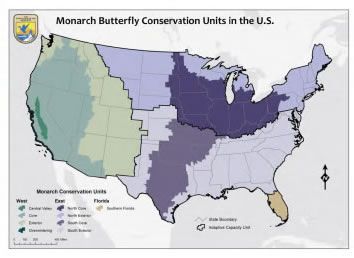
The Mid-America Monarch Conservation Strategy Board of Directors has established a goal of 1.3 billion additional milkweed stems over the next 20 years in the North Core Monarch Conservation Unit. This goal is based on the minimum number currently identified by peer-reviewed scientific publications as necessary to maintain a viable eastern monarch population.
Recently published articles call for anywhere from 1.3 to 1.8 billion additional milkweed stems in the northern conservation units of the eastern monarch population (Pleasants 2016, Thogmartin et al. 2017, Thogmartin et al. 2017a). Some estimates are based on the numbers of milkweeds needed to maintain an average of 6 hectares of occupied overwintering habitat in Mexico based on the amount of milkweed lost; the other methodology uses an estimate of approximately 29 milkweed plants necessary to produce one fall migratory adult monarch (Nail et al. 2015) and the total number of overwintering monarchs needed for six hectares of occupied overwintering habitat in Mexico.
In addition to milkweed increases in the North core conservation unit, milkweed stems will also be added in the North Exterior conservation unit through state and partner efforts and conservation programs in that area.
Monarch conservation and nectar resource goals for the South Core conservation unit, where milkweed is not believed to be limiting, have not yet been established. Still, a workshop is being planned to help facilitate their development.
Additional habitat will be added in the South Exterior conservation unit as well, through state and partner efforts and conservation programs in that area.

How will you decide how much habitat is needed and where?
A habitat planning allocation tool has been developed to help calculate how many milkweed stems might be added by enhancing or restoring habitats in various “sectors” of land, such as agricultural lands, rights-of-way, urban lands, protected grasslands, etc.
The tool is intended to help inform decisions, not to make decisions about where or how many milkweed stems will be added. Final decisions on habitat goals will be made by individual states working with partners.
When will the plan be completed and who will implement it?
Regional goals and objectives, as informed by state-level discussions among partners, will be included in the Mid-America Monarch Conservation Strategy to be completed by June 2018. Implementation will be through the application of state-specific plans and conservation efforts and will involve numerous partner agencies, organizations, and landowners.
This will be only the first phase of a long-term strategy that will require increased commitment of people and resources and enhanced monarch and pollinator implementation and monitoring efforts by many partners over the next 20 years.