VOLUNTARY BMPS
The Midwest Association of Fish and Wildlife Agencies (MAFWA) Directors, representing 13 states and three provinces, charged the Fish and Wildlife Health Committee and the R3 and Relevance Technical Working Group to address needs, challenges, and opportunities to reduce lead ingestion from spent ammunition and tackle. With this charge, members of the two committees met with state, federal, industry, and non-profit partners to pursue a collaborative path forward, emphasizing education, information, and choice as the most appropriate and potentially effective approach.
The potential impacts of lead on wildlife are complex. Hunting ammunition and fishing tackle containing lead are widely available and commonly used. The unintentional ingestion of residues from these components can cause health effects, up to and including mortality, in individuals or population impacts on certain wildlife species.
Tools are available for hunters and anglers who want to voluntarily reduce these risks to wildlife. Information and communication on conservation approaches that safeguard wildlife have long been embraced by hunters, anglers, industry, and governments in their commitment to conserving natural resources. The priority of this collaborative effort was to provide recommendations to support hunters and anglers in making voluntary, informed decisions on ammunition and tackle, and to address potential impacts, thereby avoiding regulatory measures related to the use of lead ammunition and tackle.
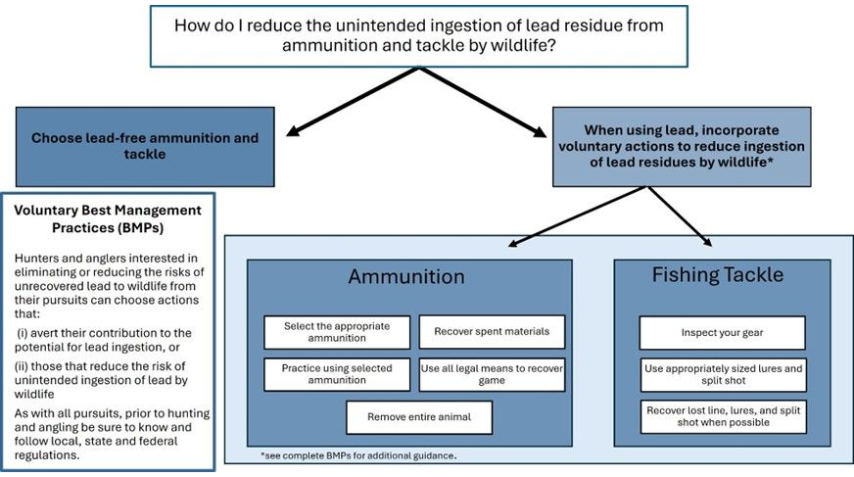
Hunters and anglers interested in eliminating or reducing the potential risks of unrecovered lead to wildlife from their pursuits can choose actions that (i) avert their contribution to the potential for lead ingestion or (ii) reduce the risk of unintended ingestion of lead by wildlife. Hunters and anglers who prefer to eliminate the potential for lead ingestion should choose ammunition and tackle that does not contain lead. When lead-free options are not feasible or desirable, hunters and anglers using ammunition and tackle containing lead can take other voluntary steps to reduce the potential for unintended consequences of spent lead ammunition and tackle on wildlife.
These Best Management Practices (BMPs) describe specific actions and alternatives recognized as effective and efficient in reducing the risk of ingestion of lead ammunition and tackle (Figure 1). BMPs are science-informed and adaptive; they evolve as new research, technology, and management priorities emerge and are designed to provide options to reduce the risk of leadings.
The practices described in this document apply only to hunting and angling activities. They are not meant to provide guidance on the use of ammunition in other shooting activities or lead use in different recreational activities. As with all hunting and angling pursuits, know the hunting and angling laws for the species you are pursuing in the locations where you hunt and fish. In specific locations and for some species, lead-free ammunition and tackle may be required.
MAFWA does not make any guarantee or assume any liability with respect to the use of any information or recommendations contained in this document and instead encourages continued research and consultation with scientists, engineers, industry, and other appropriate professionals to advance conservation outcomes and long-term support for hunting and angling. Such practices are consistent with the conservation ethic, which we, as fish and wildlife professionals, as well as hunters and anglers, continually work to manage and protect.
Reduce lead ingestion by wildlife
Removing lead bullets, shot, and fragments, and reducing the accumulation of lead tackle and shot in the landscape, reduces the risk of unintended ingestion.
- Retrieve spent materials. Recovering split shot, sinkers, jigs, and ammunition whenever possible decreases the likelihood that wildlife will ingest these materials in the future.
- Remove harvested animals in their entirety from the field. If complete carcass removal is not possible, remove the portion of the remains that are most likely to contain lead. If the remains cannot be removed, bury or cover the remains. Note: Carcass disposal options/regulations may vary among locations.
- Recover game. Wounded or lost game and fish are potential sources of secondary ingestion by wildlife. Support the use of game recovery methods (dogs, drones, thermals, etc.) to increase the retrieval of wounded and lost game and fish as permitted by regulations.
Hunting Ammunition
- Use lead-free ammunition.
- When using ammunition containing lead:
- Plan ahead to remove fragments, carcasses, or impacted meat from the field.
- Review a variety of ammunition designs and learn how they function, including the necessary changes to choke sizes. Most manufacturers provide information on specific ammunition types and the applications for which they are best suited.
- Try a variety of ammunition in your chosen firearm to determine which offers the best opportunity for the most ethical harvest. Monolithic, bonded, and controlled-expansion bullet designs are shown to result in less fragmentation. Consider performance characteristics such as accuracy, terminal performance, and bullet construction when selecting ammunition.
- Practice makes perfect – Practice with your choice of ammunition to improve your shot, to reduce bullet fragmentation.
Fishing Tackle
Selecting and maintaining appropriate tackle and limiting tackle loss protects wildlife from unintended lead ingestion.
- Use lead-free tackle.
- When using tackle containing lead:
- Inspect your gear. Inspect and replace, if needed, leaders and lines to make sure they are competent and unlikely to break under normal use.
- Use the appropriate size of jigs/split shot. Selecting sinkers and jigs greater than 1 oz and longer than 2.5 inches provides the best protection to water birds, including loons, against exposure to lead from tackle. Using larger split shot, sinkers, and jigs can help reduce the risk of unintended lead exposure to wildlife.
- Recover lost sinkers, split shot, and jigs whenever possible, including lines lost in shrubs, rushes, and trees, which can become accessible to waterbirds over time